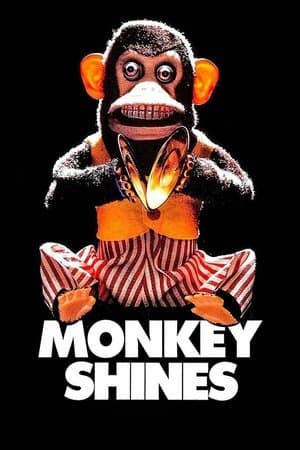
When I first read the news that one of my favorite modern directors, Osgood Perkins (Longlegs, The Blackcoat’s Daughter), would be directing The Monkey, the article was accompanied by a familiar image: a toy monkey with a cracked-out face, banging two cymbals together. My brain immediately went to George A. Romero’s underappreciated 1988 film, Monkey […]
When I first read the news that one of my favorite modern directors, Osgood Perkins (Longlegs, The Blackcoat’s Daughter), would be directing The Monkey, the article was accompanied by a familiar image: a toy monkey with a cracked-out face, banging two cymbals together. My brain immediately went to George A. Romero’s underappreciated 1988 film, Monkey Shines.
I also immediately assumed Monkey Shines was based on a King story—a natural assumption. What hasn’t King written at this point, after all? In reality, of course, Perkins/King’s The Monkey has absolutely nothing to do with Romero’s Monkey Shines. But while the two properties aren’t officially connected apart from their similar imagery – oddly enough, Perkins had to redesign the toy monkey from King’s story due to a Disney copyright! – they do have a few things in common. Both Monkey Shines and The Monkey feature bat-shit crazy stories full of dark humor, both helmed by fearless directors. So, if The Monkey’s release in theaters this week gives you a reason to revisit Monkey Shines? It’s (Os)good a reason as any!
George A. Romero’s Monkey Shines began as a novel written not by King, but by novelist Michael Stewart. The rights eventually landed in the hands of Orion Pictures, who wisely hired Romero to direct, specifically because of the Dawn of the Dead director’s ability to seamlessly inject dark humor into tragic horror stories.
This is immediately apparent in Monkey Shines as we meet our hero, Allan (Jason Beghe), and experience the harsh dismantling of his life. He’s a handsome, happy guy with a beautiful woman in his bed, out for a run with a backpack full of bricks. The world seems beautiful—where the sun is shining and passerby cyclists toss out high-fives instead of blocking traffic when you’re late for work. That is, until the moment a dog jumps out and scares Allan face-first into a moving truck.
Allan then wakes up to the harsh reality that he is paralyzed from the neck down. His girlfriend leaves him for the “genius” doctor who’d supposedly fixed him (). His nurse often quotes the Bible but is only a set of wings away from being a spawn of Satan herself. His mother is an overbearing guilt machine with a smile, and his best friend, Geoffrey (), is like a depressing ’90s “HBO Special” version of ’s Herbert West. It’s a positive for the audience, because Geoffrey feels like he came directly from a Frank Henenlotter set. But it’s terrible for Allan, who even attempts to suffocate himself to death in some dry-leaning plastic.