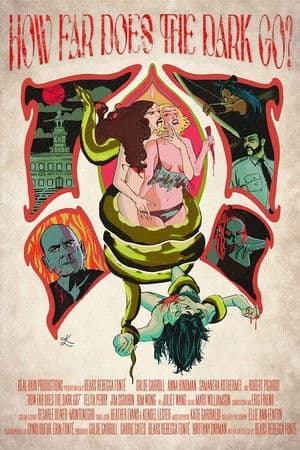
It’s evident early on what kind of influences Bears Rebecca Fonté is drawing on for her sophomore feature film, How Far Does The Dark Go? The multi-hyphenate creator (she writes, directs and edits) has stated that her latest movie is indebted to titles like The Hunger, The Lair of the White Worm, and Vampyros Lesbos, […]
It’s evident early on what kind of influences Bears Rebecca Fonté is drawing on for her sophomore feature film, How Far Does The Dark Go? The multi-hyphenate creator (she writes, directs and edits) has stated that her latest movie is indebted to titles like The Hunger, The Lair of the White Worm, and Vampyros Lesbos, as well as soundtrack-dominated movies of the ’90s like Cruel Intentions, Jawbreaker and The Crow.
For audiences, this is either a selling feature…or a warning.
How Far Does The Dark Go? chronicles the tumultuous relationship between alluring female vampire Evienne (Chloe Caroll) and human nurse Grace (Anna Hindman). The latter is abducted by Evienne and held prisoner in order to care for Evienne’s cancer-stricken human son, Henry (Robert Picardo), but over the course of several Stockholm Syndrome-y months, Grace begins to develop feelings for her captor.
Naturally things build into an intense physical relationship that involves sexy dreams, lingerie, bloody bubble baths, and unconventional fluid exchanges. Questions linger, though: has Grace simply been glamoured into falling for Evienne? Is the vampire truly a monster, as Henry suggests, or does she have any humanity left? And is Grace more susceptible because of her morphine addiction?
Several of these questions, as well as the vampire lore that Fonté develops (or borrows from other texts such as the aforementioned works by Tony Scott, Jean Rollins, as well as the physical movements of vampires from True Blood) are the film’s most intriguing aspects. Alas How Far Does The Dark Go? is far less interested in its narrative than in its vibe, which often feels at odds with the story and characters.
Clocking in at nearly an hour and forty-minutes, the film is best understood as a sexy, campy mixtape rather than a feature film. Fonté eschews a conventional score in favour of innumerable generic pop songs that play in the background of nearly every scene; occasionally the lyrics underline the content of what is happening on screen or helps the film maintain a certain energy, but just as often the soundtrack pulls focus.
If songs were used less frequently and more strategically – say, to accompany the transitions or a montage – they would be effective, but very quickly the music becomes a source of frustration. At a certain point it seems like the songs are Fonté’s main focus and the constant jukebox shifts are so noticeable that it is difficult not to count the sheer number of them (I stopped when I hit 10+ in the first forty minutes).