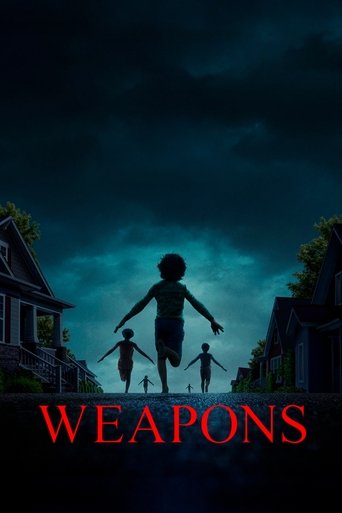
“Won’t somebody please think of the children!” – Helen Lovejoy, Springfield pearl clutcher. Horror often tickles itself, antagonizing the Helen Lovejoys of the world. You know the type: professional pearl clutchers who consider themselves card-carrying members of the moral majority, like the Simpsons character. They talk a great game about doing it all for the […]
“Won’t somebody please think of the children!” – Helen Lovejoy, Springfield pearl clutcher.
Horror often tickles itself, antagonizing the Helen Lovejoys of the world. You know the type: professional pearl clutchers who consider themselves card-carrying members of the moral majority, like the Simpsons character. They talk a great game about doing it all for the kids, but it’s all talk. Horror sees through them; the genre pokes but realizes anyone willing to use children as set decoration for their latest holier-than-thou cause is truly dangerous. As long as they benefit, no one else’s suffering matters.
Weapons is the latest in a long line of flicks that show how kids are weaponized to pull people apart at the seams. And its violence reflects a society that’s grown increasingly vicious and cruel when it comes to using the young ones as props.
There’s never any shortage of anger, rage, and despair when children go missing or worse. Zach Cregger’s latest wrestles with those emotions—not to submission but to understanding. It’s easy to look at a dad sideways after learning he painted “witch” on the side of a teacher’s car. It’s reasonable to tsk-tsk said teacher for going above and beyond her call of duty to do a wellness check on a child while defying her boss’s explicit instructions.
But Weapons paints just enough of a portrait to make their actions understandable. The people in this flick’s small Pennsylvania town embody the saying about what type of measures desperate times usually call for.
Understanding their actions might be easy for most, but that relatability doesn’t make them any less extreme.
Horror bathes in extremes. Its acute understanding of how far adults will go to save or defend a child creates more insightful and complex stories. And it’s never shied away from showing how that passion to protect might be perverted and lead to pandemonium. The genre’s done that over the years by looking out the window. Way back when, the powerful feared that forces outside their communities, like movies, television, and even comics, might morph the next generation into deviants. Quarantining the impressionable youth from anything outside of the chosen norm became paramount.
The radiation-infected brood in The Children had to die before they infected everyone else. It was more or less the same for the ten-year-olds born under a bad sign in Bloody Birthday. These movies represented the fear that something foreign might invade the neighborhood, thus making it easy to point fingers at outsiders. As the clock ticked forward, the shift to anxiety over more pop culture-pervasive topics created a rift. Those prone to moral panic in the late 20th century fretted not only over sex, drugs, and rock & roll, but also over different religions, lifestyles, and philosophical beliefs when “thinking of the children.” The more ubiquitous those subjects became, the more likely a sexually active weed smoker shared a fence with someone who wouldn’t dare. Those fingers that once pointed outside the comfy cul-de-sac now reversed their direction.
Horror responded in kind. Creatives produced films showing how quickly the most civilized folk turn away from the law and against each other when something sinister strikes their seeds. Many a Halloween, Friday the 13th, or slasher du jour show outbursts between people who probably serve on the PTA together. Or individuals within arm’s reach of a firearm, relieving law enforcement officers of their duties because they suddenly know best. But even as movies put more kids’ lives at risk, the neighbor-on-neighbor crime was relatively tame. People toyed with possibly overturning everything to protect their young from what they perceived as more dangerous threats, but they never followed through. Those angry mobs were more bark than bite, reflecting a somewhat still-in-check society.
Then came the “post era.” The time where we now collectively say “post Columbine,” “post 9/11,” “post Great Recession,” “post Sandy Hook,” “post Covid,” post pretty much everything that’s happened since the 21st century began. Society feels a lot less in check, and the days of satanic panic feel quaint. As threats to children multiply seemingly by the second, we’re more easily at odds in how to protect them. The Helen Lovejoys have more avenues to profit from angst, which isn’t exactly in short supply these days. Like any horror baddie worth their salt, they grow stronger as the societal bonds weaken.
Those same angry mobs from thirty or forty years ago are now militias ready to do harm because a bunch of someones told them they are their children’s last line of defense. Worshipping differently or not worshipping at all went from being worthy of a gasp or two to behavior that can indoctrinate the youngins.
For far too many, thinking about the children is a Trojan horse for homogeneity or whatever battle in an exhausting culture war they feel like fighting when the sun comes up.
The tykes are merely tools in warfare, making Cregger’s film perfect for this moment. Aunt Gladys is the stand-in for pearl clutchers and hustlers alike. She snatches kids for her benefit and then watches the town crumble to pieces. She tells her young supposed nephew that all the misery and strife, including his own, is for some imaginary greater good. Gladys not only weaponizes the youth but also the emotions associated with them. To maintain the charade that the kids’ disappearance is an unsolvable tragedy, she unleashes physical violence on the residents, often by their own hands.
The film’s brutality is shocking but appropriate for today’s landscape. Is it overkill watching a husband under a witch’s spell repeatedly bash his spouse’s head into their kitchen floor until the skull and the floor are gushy and bright red? Possibly. But that’s no more extreme than watching footage of countless school shootings and offering nothing but thoughts and prayers. Indifference can also be cruel, and the flick pits that numbness on display with some townspeople just moving on from the tragedy without batting an eyelash. Weapons creates a buffet of violence using different flavors of savagery ranging from seemingly banal to shockingly aggressive. This crescendos with the kids turning on their captor and ripping Gladys into tiny Gladys pieces.
It’s an obvious metaphor, but sometimes things are obvious for a reason. The children tear Gladys apart just as she ripped apart their town. She hid behind those same kids for weeks, only for them, with her nephew’s help, to quicken her departure from this plane of existence. Weapons doesn’t hold back either. It doesn’t cut away or pretty up the scene. It’s the most unhinged moment in a movie overflowing with them. It dares the audience to look anywhere else but the screen.
It also lingers on the blank stares once the spell is undone on the count of the witch’s body getting splayed all over a manicured lawn. Ding dong, the witch is dead, but at what cost? All horror, especially Weapons, knows there’s a hefty price associated with using children as wedge issues. Those who beg and plead for anyone to do something for the kids have no problem leaving them with the bill.
The genre side eyes people who care when it’s convenient, only to move to the latest headline that suits their often hypocritical moral mission. Calling it performative only insults performers. Weapons stands on the shoulders of the films before it that take these types to task. Yet it also acknowledges we’re much easier prey now for those who divide us due to multiple reasons that future sociologists will write thesis papers about. Thinking about the children should mean coming together on their behalf, not letting anyone split us into tribes.