The Oscar winner takes some liberties, but there are some surprising similarities too.
If you’re expecting Guillermo del Toro’s new Frankenstein movie to be a beat for beat adaptation of Mary Shelley’s novel — which it seems like most people are, based on the discourse I’ve seen online — then you’ll probably be pretty disappointed. I got a chance to see it in theaters ahead of its premiere on Netflix, and having read the novel numerous times both for education and for fun, it’s not too tough to pick out the Shape of Water director’s changes.
But what exactly has changed? Guillermo del Toro has always had his own, unique way of telling a story, and Frankenstein is no exception. I think of it as being closer to Hayao Miyazaki’s take on Howl’s Moving Castle than a dry BBC drama: true to the core themes of the novel, while still making some changes that serve the director’s aesthetic style and a modern audience.
This is not an exhaustive comparison of del Toro’s vision and Shelley’s original story — I’m only one woman, I can only cover the basics! If you truly do want that, you can pick up a copy of our Frankenstein bookazine, which tracks the entire history of the story on-screen, as well as diving deeper into Netflix’s newest adaptation.
But for now, let’s begin with the big stuff — which will obviously include many, many spoilers. You’ve been warned.
Frankenstein & The Tale of the Missing Frame Story
Two major scenes (and perhaps the most important elements of the original story) remain as they are in Shelley’s novel: the original frame story, and the Creature learning to read. (That’s an oversimplification, but just give me a second here.) Most adaptations of Frankenstein begin with Victor pretty immediately creating the Creature, but that’s not how the story originally goes. In his film, del Toro has retained the version of Victor we meet initially in the novel: half-frozen, dying, and scared for his life out on the ice of the Arctic, as he stumbles upon the crew of a ship bound for the North Pole.
The film begins and ends with Victor (and eventually, the Creature) telling the story of his creation to the ship’s captain, a device traditionally discarded for the sake of brevity. In del Toro’s version, it’s used not only for authenticity, but to give the Creature more of a voice than he gets in the novel — typical, for a man so devoted to humanizing monsters — and the only major change is that we cut back to Victor and the Creature on the boat far more than the novel does. (Mostly so that Jacob Elordi can act his undead butt off. I said what I said.)
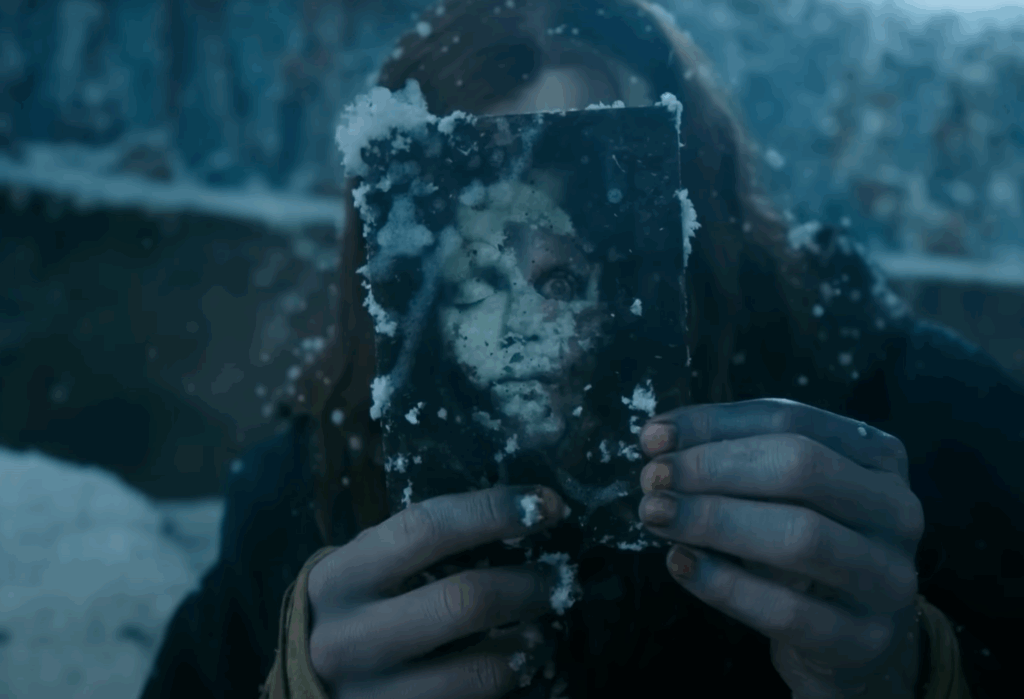
This use of the frame story also gives us the opportunity to see what I consider one of the greatest scenes from the novel. In most adaptations, The Creature remains an unspeaking, grunting brute, but Shelley’s original creation is intelligent and well-spoken, as learned through interactions with a blind old man, and del Toro is one of the few directors to ever deliver on one of the book’s most heartbreaking passages.
In both the novel and the film, we see the Creature learn to speak by reading to the old man, who comes to consider him a great friend and a good person. It’s the scene where Elordi gets to shine the most, and where the Creature ultimately comes to understand the violence of the world he lives in when he’s chased out of the old man’s isolated cabin by family members who see him as nothing but a monster. It’s no surprise that, for a director so focused on connecting with monsters rather than scorning them, this would be one of the film’s key sequences, retained almost beat for beat from the book.
But, as with most adaptations, even the best filmmakers (and del Toro truly is one of the best) stray from their source material more often than not. So, while the basic story of Frankenstein remains the same in this particular film, many of its core details do not.
From College to the Chemistry Lab
Oscar Isaac in FRANKENSTEIN (Credit: Netflix)
Perhaps one of the most interesting changes del Toro makes to the story of Frankenstein — though it may be a controversial one — is altering the age and vocation of Victor Frankenstein, our central protagonist. Rather than a young student at the University of Ingolstadt in Germany, Isaac’s Victor begins the story as a middle-aged surgeon in Edinburgh, freshly fired from his role in the Royal College of Surgeons for his work as a resurrectionist.
The film also shifts Shelley’s story from the beginning of the 19th century to the mid 1850s, which, while it robs of us of the Victor that Shelley created, plants her Modern Prometheus firmly in an era when grave robbing — both for dissection at medical colleges and attempts at creating life from dead tissue — was a fact of life, a reality that proves truth is always stranger than fiction and makes his social upbringing a key part of his eventual madness. (Look up the Burke and Hare murders if you don’t believe me. Victorian society was wild.)
More Than One Mad Scientist
Christoph Waltz in FRANKENSTEIN (Credit: Netflix)
Victor’s experiments are also funded by Christoph Waltz’s wealthy arms dealer Henrich Harlander, the only major character invented entirely for the film. While Harlander is the source of the funds Victor needs to achieve his success in the film (and the benefactor of his large laboratory, reminiscent of the one from James Whale’s film), this is one of the largest diversions from the novel, one that goes hand in hand with changing Victor’s age.
In Shelley’s original tale, Victor creates the creature on his own, away from the prying eyes of society, fueled only by his obsession with playing God. Entangling him with a sponsor is a change that brings del Toro’s Frankenstein much closer to the mad scientist tropes we’re so familiar with today, and replaces the voices of reason in Shelley’s novel — notably, Victor’s school friend Henry Clerval, the one character who never seems to make it to the screen in any Frankenstein adaptation. (Except, oddly, when Whale swapped his and Victor’s names in the 1931 film?)
The Love of Victor’s Life Has a Love of Her Own
Mia Goth in FRANKENSTEIN (Credit: Netflix)
The invention of Harlander also has major repercussions for a pre-existing character from the novel: Elizabeth, turned from Victor’s childhood friend and fiancée to Harlander’s niece and Victor’s future sister-in-law. In order to beef up the role of Victor’s little brother William in the film — perhaps also to replace Clerval — Elizabeth also undergoes perhaps the most significant change from the novel to the screen in del Toro’s adaptation.
While she’s primarily remembered in the novel for dying at the hands of the Creature on her and Victor’s wedding night, del Toro's Elizabeth is instead a scientist of her own merit, who sympathizes with the Creature in a way Victor cannot. Victor longs for her while never being able to understand her, and her death is even more firmly shifted to be the direct result of his hubris, a change that seems to motivate one of the biggest diversions from Shelley’s original tale: the ending.
Both Shelley’s original story and del Toro’s end with Victor dying aboard the ship he’s rescued by, but what happens to the monster is where things diverge. Victor dies in Shelley’s novel, still determined to destroy the Creature, but del Toro pumps the brakes, choosing instead for the father to embrace his creation, both absolving each other of their sins as Victor tells the Creature to embrace the sunlight as he dies. Whether that ending will sit right for you depends on how much of a Frankenstein purist you are, but it only seems right for the Oscar-winning king of monsters to wrap things up on such a hopeful note.
Guillermo del Toro’s Frankenstein is streaming now on Netflix.