Looking back at a forgotten 40-year-old gem through a horror lens.
By 1985, Steven Spielberg was at the height of his powers. From Raiders of the Lost Arc and E.T. the Extra-Terrestrial to The Goonies and Back to the Future, it seemed like, as both a director and producer, everything he touched turned to gold — everything except for a Victorian-era adventure film about literature’s greatest detective.
Written by Gremlins and Goonies screenwriter Chris Columbus, 1985’s Young Sherlock Holmes was a Spielberg production that received mixed reviews and underperformed at the domestic box office. The script was not based on any existing work, but instead ponders a “what if” scenario where the great detective meets his trusty partner, John Watson, as a teen in boarding school, and explores a possible tragic superhero-esque origin story explaining why the titular character grew up to be such an emotionally detached single-minded loner in Sir Arthur Conan Doyle’s original stories.
In the decades since its release, Young Sherlock Holmes has developed a small but loyal following, consisting mainly of those who grew up with it on VHS and as a cable TV staple. However, due to limited availability for much of the 2000s, it has largely flown under the radar for post-video-store generations.
On its surface, the film is a fun ‘80s “kids on an adventure” film, made with a large budget, set in 1870s England, directed by Barry Levinson (director of Diner and Rain Man), and gleaming with a Spielbergian luster.
So, why is there an article about it on FANGORIA? Is it even a horror movie?
To answer those questions, one could examine the film’s surreal murder scenes, which feature a range of nightmarish visuals, from zombies to anthropomorphized food. Alternatively, one could delve into the technical details of its impressive special effects, created by Industrial Light & Magic and including the first fully computer-generated character to appear in a feature film — a medieval knight made of stained glass.
One could also point to the film’s apparent influence on more popular adolescent boarding school content, such as the Harry Potter books and film series, which Chris Columbus directed the first two installments of, or Tim Burton’s modern gothic Netflix series, Wednesday. One could even write about howEdgar Allan Poe, America’s original master of horror, invented the modern detective story and helped inspire the creation of Sherlock Holmes. However, this article will instead examine this glossy, family-friendly whodunit through the lens of Italian horror.
The giallo subgenre has been called the slasher film of Italian horror, but unlike American slashers, gialli (the plural form of giallo) have distinct literary roots. The term “giallo,” meaning yellow in Italian, is a shorthand designation that initially referred to a specific type of inexpensive pulp mystery paperback novels, typically bound in yellow covers, and first published in 1929. The earliest giallo books were Italian translations of existing English-language mysteries, including Doyle’s Sherlock Holmes books, as well as the works of Edgar Allan Poe, Agatha Christie, Raymond Chandler, and many others.
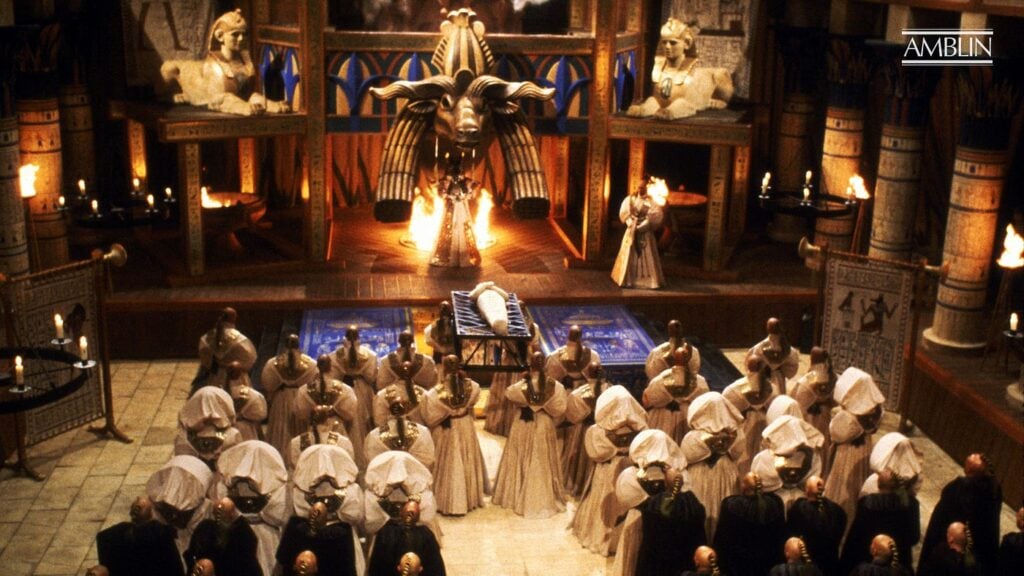
YOUNG SHERLOCK HOLMES (Credit: Amblin)
Like most giallo films, Young Sherlock Holmes is a whodunnit. Its plot revolves around a series of strange murders, the investigation into their perpetrators, and the attempt to stop them. At their core, this is the general plot to most, if not all, gialli. However, though every giallo is a whodunnit, not every whodunnit is a giallo. So, what are some of the other important identifying characteristics of the subgenre?
Young Sherlock Holmes is rated PG-13 and is a period piece that is intentionally suitable for family viewing. So, die-hard giallo aficionados will be sad to find that there is no gratuitous J&B Scotch product placement or strong sexual themes. However, when compared to a list of other giallo cinematic hallmarks, the film checks most of the boxes.
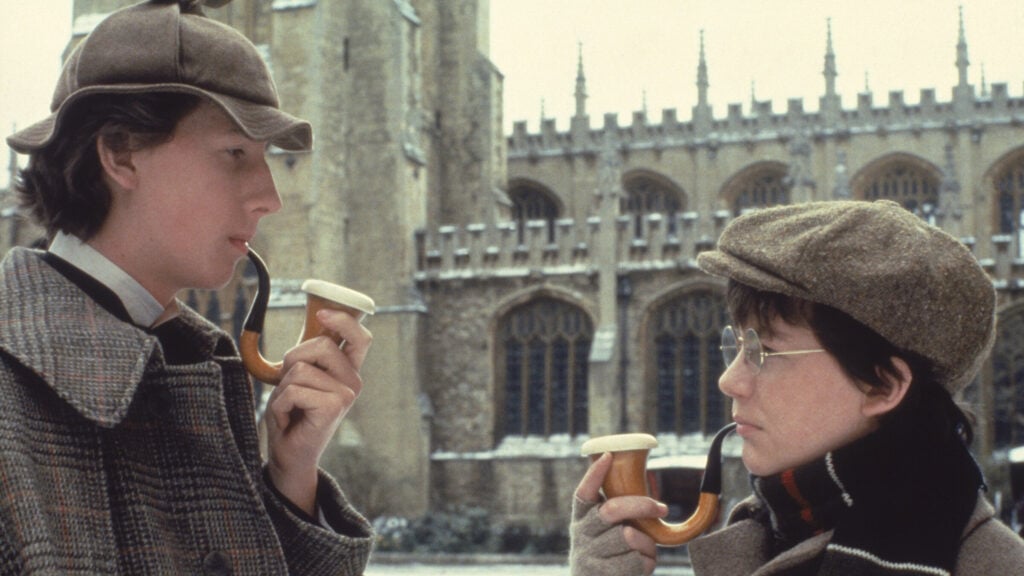
The amateur detective: At age 16, Holmes is a student at a boarding school. He, his new friend Watson, and the object of his affection, a fellow teen named Elizabeth, are thrust into a high-stakes game of cat and mouse as they try to solve a series of murders without becoming victims themselves. Also, like most gialli, the police are more of a hindrance than a help.
YOUNG SHERLOCK HOLMES (Credit: Amblin)
The mysterious killer: The killer here may not wear a hat, a black trench coat, and matching leather gloves (as in many standard gialli), but they do hide their identity behind a hooded cloak and their own style of matching gloves.
Elaborate murder scenes
A key part of a giallo, and Italian exploitation in general, is a series of perfectly spaced attention-grabbing and often graphic killing and/or sex scenes. The reasoning behind this is rooted in the movie theater-going habits of Italians during the 1960s and 1970s. (We will delve deeper into this later.) In Young Sherlock Holmes, the graphic aspect of the murders does not come in the shape of excessive blood and nudity.
The murder weapon is not a knife, razor blade, or other phallic penetrating tool; it is instead a blowgun armed with darts soaked in a strong hallucinogenic, and phallic in its own way. Once struck by a dart, the victims experience terrifying hallucinations that lead them to harm themselves.
Cinematically, the sequences may not be as graphically explicit as their counterparts in horror films like the A Nightmare on Elm Street series, but, created by Industrial Light & Magic, they are visually stunning, imaginative, polished, and in some cases, technically groundbreaking. Like the murders in any giallo, they are a visceral assault on the senses.
Memory
In one way or another, memory plays a role in many gialli. Whether it is amnesia, repressed memories, or a witness’ (often the protagonist’s) unreliable account of critical events, memory is a crucial theme for the subgenre as a whole. In Young Sherlock Holmes, there may not be as much emphasis placed on memory as in other giallo works, but it remains important. Both Watson and Elizabeth recall hearing the sound of tiny bells at various points throughout the film, which they later realize is an important clue, and Sherlock’s ability to recall seemingly insignificant details helps him crack the case.
Visual aesthetic
When classifying a film as a giallo, many enthusiasts place great importance on visual style, often highlighting stylish camerawork and an exaggerated, colorful lighting palette. In that sense, Young Sherlock Holmes will surely fall short for those viewers. However, one could argue that those elements are really hallmarks of only a handful of the subgenre’s filmmakers and not characteristic of all gialli.
Regardless, if the reasoning behind the visual aesthetic is examined instead of the aesthetic itself, viewers will find that this film’s hallucination sequences, gothic elements and tone, and the striking set design of the finale, help create a surreal dreamlike atmosphere similar to what the Italian filmmakers were attempting to achieve with their own visual style.
An insignificant plot
As mentioned earlier, the movie theater-going habits of Italians in the ’60s and ’70s helped shape the gratuity and pacing of set pieces in giallo works and other exploitation cinema of the era. In one of the more academic books about the subgenre, La Dolce Morte: Vernacular Cinema and the Italian Giallo Film (published in 2006), author Mikel J. Koven explains that, according to a 1992 article titled “A Forkful of Western” by Christopher Wagstaff, Italy did not have a significant television culture for much of the 20th century.
A primary source of entertainment was the cinema, particularly in regions outside major cities. Attending the cinema was a frequent occurrence and a social gathering. Similar to live-streaming a film and posting about it on social media today, or texting with friends, Italian moviegoers used to socialize during the film. They did not particularly care which film was showing. They were often not concerned with arriving on time for its start and would frequently exit and re-enter throughout the screening.
In this context, it becomes clear why the plots of Italian exploitation films often seem insignificant and confusing. The story did not really matter to a significant portion of the audience. People were often not paying attention to the plot, and graphic violence and sex became a tool to draw people’s attention back to the screen.
It is, perhaps, in this way that Young Sherlock Holmes is most genuinely giallo. To call the film’s motivations for the murders insignificant and confusing would be an understatement. Literally, if one were to sneeze at the wrong moment, they would miss the entire explanation. This weak bit of exposition would be considered a flaw in most popular cinematic works, but within the context of giallo, it feels perfectly authentic.
Giallo purists will likely scoff at the above comparisons to Italy’s homegrown thriller. Horror purists may reject the notion that Young Sherlock Holmes is a horror film at all. Even some fans of the film itself unfairly compare it to Indiana Jones and the Temple of Doom, but one undeniable fact is that it is fun. For anyone craving adventure, with a hint of horror and loads of imagination, this 40-year-old underseen gem may just be the perfect thing.
For more Young Sherlock Holmes, check out this nightmare scene Digital Editor Angel Melanson shared on the Halloween episode of VCR Party Live.