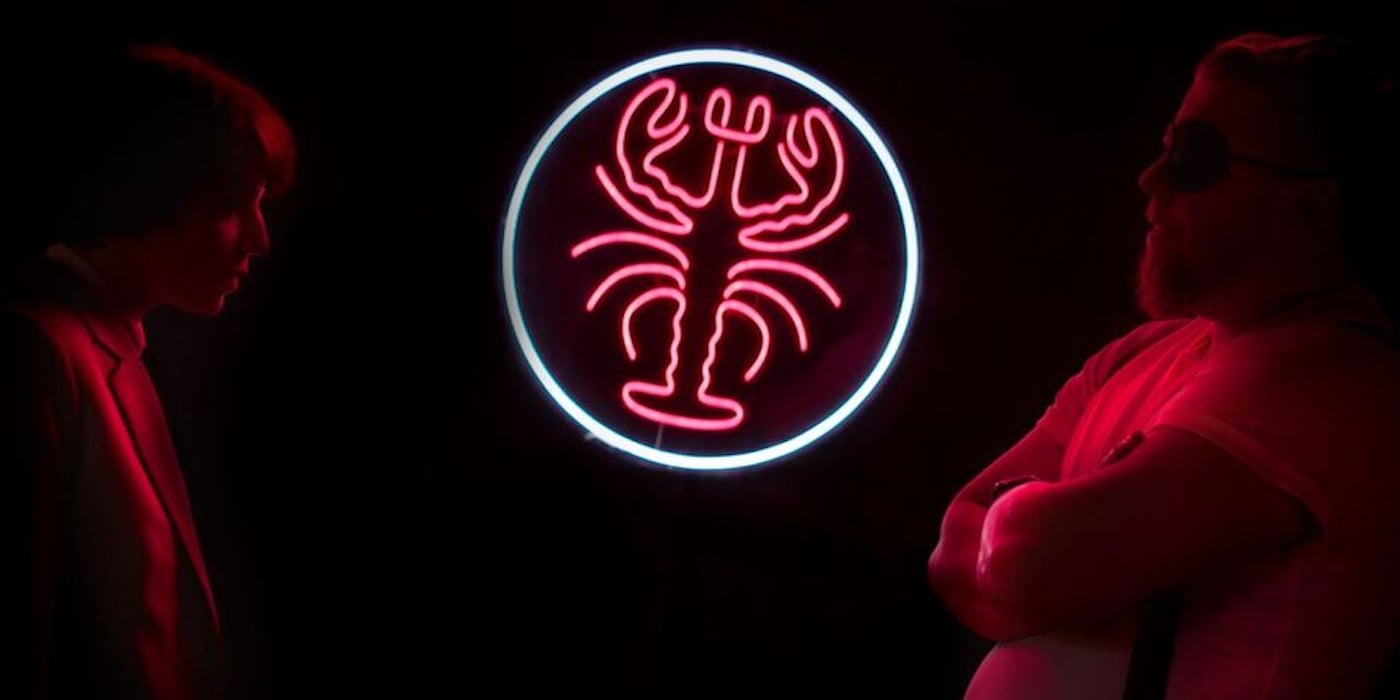
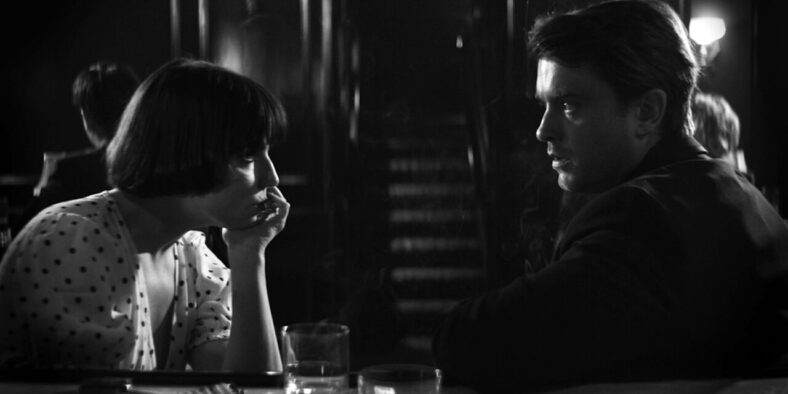
Crooks’ writer/director, Mickey Keating, along with stars Angela Trimbur and Melora Walters, spill the secrets on the slick crime caper.
Coming from the twisted mind of genre savant Mickey Keating (Darling, Carnage Park, Psychopaths), Crooks is a glorious throwback to the hard-boiled crime capers of the ’40s and ’50s, albeit filtered through an ultra-stylized lens that evokes the vibe of pulpy EC Comics. Set in Chicago’s crime-soaked seedy underbelly, where everyone is looking out for themselves and one bullet away from a betrayal, Faye (Angela Trimbur), a former con artist-turned-lounge singer, desperately turns to one last get-rich-quick scheme when she’s down on her luck. What follows is a disturbing domino effect of destruction that leads to a growing body count and a whole lot of cash.
Writer/director Mickey Keating, along with stars Angela Trimbur and Melora Walters, breaks down Crooks‘ heightened world, finds compassion in hardened characters and in the power of loneliness, and explains why Keating is excited to “make as many horror movies” as he possibly can in the coming years.
DREAD CENTRAL: What I love about all your movies is that there’s such clear passion for the genres that you homage and deconstruct. You’ve tackled a lot of horror and crime in the past, but never quite a pulpy grindhouse heist like this. Is this space that you’ve wanted to tackle for a while?
MICKEY KEATING: Yes, absolutely. And you kind of see that in some of my other films. Carnage Park, I would say, was the spiritually closest to Crooks. But from the minute I realized that I wanted to make movies when I was very young, I was always kind of drawn towards the crime genre. And in my mind, when I was dreaming about making this movie years ago, it didn’t seem like that far of a leap for me to jump into. I’m not going to suddenly spin into a comedy or something like that. It really felt like a tonally natural progression of what I’ve been doing, and that was very exciting and inspiring to do.
Long ago, I was working on a far different film called Crooks, and I just really liked the title. I shot a movie called Invader in Chicago with producer Edwin Linker. That went well, and we really liked working together. So I was like, “Why don’t we shoot a crime movie here? Chicago has a million stories about crime!” And fortunately, Eddie said yes. So this has been a long time in the making. We shot this two years ago, almost to the day.
DC: I saw a lot of Robert Rodriguez and Don Siegel – even some of Warren Beatty’s DickTracy – in Crooks. What were some of the biggest influences on Crooks‘ vibe and style?
MK: I feel like, starting with Offseason, I started to consciously think about movies less in terms of individual references and more in terms of the spirits of the genres that I’m attacking and the feelings that they invoke in me. So for Crooks, I definitely wanted to have– there are so many innumerable movies from the ’40s and ’50s that I’m obsessed with. Same thing with going into the ’60s and French New Wave. So I was really like, trying to capture that spirit, and then let’s watch the movie – for lack of a better term – bleed into a heist film, a neo-western, the “bag of money and everyone’s on the take” movie.
I think one of the big movies that we talked about in terms of spirit was this movie from the ’40s, Gun Crazy. Even though the movie’s not really similar in story, it still has this kind of energy that you just come to love about those hard-boiled pulp movies. So it was really just about capturing a spirit more so than homaging a particular director or movie.
DC:Faye is such a force of nature and a character who you can’t take your eyes off. It’s such a tricky type of role to nail, and the whole movie kind of falls apart if you’re not hitting the right tone. What was the process like to find this character?
ANGELA TRIMBUR: Well, I think it was all about finding the compassion to have for Faye so she’s not just this gunslinging, money-looting con artist woman. There are reasons behind everything she does that get to the heart of her character. Mickey and I talked about her past as a carnival barker as a young child. She kind of grew up in the carnival system, and she’s always kind of been hustling. Her parents then later abandoned her, so she doesn’t trust anybody. That’s just a really interesting thing to play with in the sense that Faye can’t trust anyone and only has herself because that’s the only person who is going to be there for her in the long run.
There’s something that’s really sad about that as your motto in life, but to also still have all these dreams that have been squashed. She’s been disappointed nonstop in life and feels like she’s getting lower down and farther away from what she thought her life would be like. It’s not easy to carve your way out of that and do whatever it takes to survive.
DC:You mentioned trust being such a big part of Faye’s character. You’ve worked with Mickey on several films now. Is there a certain level of trust there when it comes to playing such heightened roles?
AT: Oh yeah, he has such specific visions. He sits with his characters for like decades. So it’s really exciting to be able to play with something that’s marinated for so long. Faye is such a force of nature. The way that Mickey writes characters for women — these female protagonists — who are just so messy, relatable, and surprising. They’re all really lonely characters to play. There’s something really exciting about playing a character that’s lonely because everything is just driven with a really dim hope. To feel like Faye needs to put on this facade in order to get to the next thing, so she’s as soft as she is on the inside. It comes from this hardened way of surviving.
Courtesy of Missing Link Productions
DC: The whole film enters this haunting headspace when Blanche takes over. So much of her character goes unspoken for and is left open to interpretation, but what were you channeling in that moment when she has that confrontation with Faye?
MELORA WALTERS: I think that Blanche is in survival mode. It’s mostly men that come into the diner, and so it’s a sense of navigating that. In the end, it becomes a case where she is like, “How do I use this to get out? What do I have to do? I’ll do anything.”
DC: You tap into this feral energy that’s really powerful.
MW: I think she’s very much operating on a reptilian survival brain. An animal in the wild isn’t fearful, per se; it’s just an animal in the wild, and it needs to eat. And it’s not in a safe space, and it needs to get out; then it’ll do whatever is necessary. It kind of feels like Blanche works like that. Mickey, there was one film that you told me to watch for Blanche. It was that old black-and-white one about the woman who’s a prostitute.
MK: The Naked Kiss!
MW: Yeah, so The Naked Kiss is as human as Blanche gets. She knows she’s going into a situation where no one knows what she’s done or who he is, so she creates this thing, but underneath it all, she’s an animal.
DC: You really take over the second half of the film, and it’s such a terrifying turn. Are you excited to see how that plays with an audience and how that moment connects?
MK: It’s going to be exciting. We’ll see what happens. Maybe they’ll riot!
DC: Is this a universe that you’d be interested in returning to? It feels like there’s so much more that you could do here, even if it’s with completely different characters?
MK: 100% I expect that I’ll continue to make as many movies as I can before I keel over, and I would love to make more movies within this kind of world. And you’re right, who knows what can happen? Whoever makes it out of this one could go on to immediately rob a bank next. We’ll see what happens!
Angela, You’ve had such a rich, diverse career when it comes to your different horror performances. Is there anything that you haven’t done yet that you’d like to tackle?
AT: I would love to be in a rom-com. I feel like the art of the rom-com is something that would be fun to live in. There’s a lot of physicality to the characters that I like to play. I hope to always be able to dance and move and embrace different kinds of characters. But that whole classic, “papers everywhere, oops, meet the love of your life” kind of thing would be really fun.
DC: Melora, are pulpy, hard-boiled crime capers a genre that you have a lot of affection towards? Was it a challenge to step into such a heightened, stylized universe?
MW: I just love it all. I love acting. I love it. I love becoming someone else and trying to become what the creator had in mind. I just, truly, love it.
Mickey, do you know what you’re working on next and is it a proper return to horror? Will you be back in that space soon?
MK: Yes. I think what’s next is either a book adaptation that I’m not allowed to reveal what it is yet or a good old-fashioned ’70s style disaster movie. Those are the two kinds of genres that I want to take on next. But yeah, I definitely expect to make as many horror movies as I possibly can.
Crooks premiered at this year’s Tribeca Film Festival. Stay tuned to Dread Central as we hear more about its future release plans.