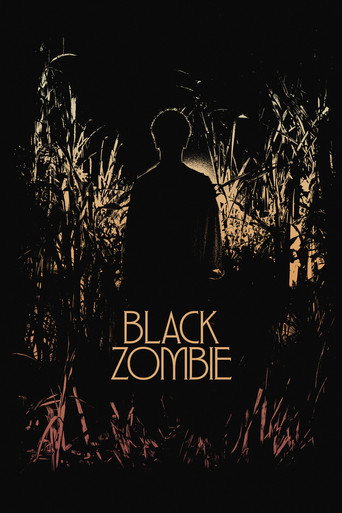
The creature feature subgenre was born from Haitian vodou and the realities of slavery, which ‘Black Zombie’ explores thoroughly and artfully.
What’s the link between slavery and zombification? One could argue that being turned into a zombie makes you a slave, especially to the hive mind. But if you watch Maya Annik Bedward’s documentary Black Zombie, you’ll realize there’s more to the story. Bedward’s film delves into the legacy of Haitian Vodou, revealing the secret history of rogue practitioners who created zombies in real life.
Bedward artfully threads the needle between Caribbean spiritual practices and what we’ve seen on screen in the U.S. and Europe. Think: The Walking Dead universe, anything by George A. Romero, the zombies of Michael Jackson’s “Thriller” music video, the 28 Days Later saga. If you consider yourself a movie buff or love learning about the so-called occult, you’ll surely get a lot out of Bedward’s Black Zombie.
Bedward’s documentary is split into several chapters, including “The Crossing,” “Dead Men Working In Cane Fields,” “Return of the Haitian Zombie” and “The Uprising.” If you’re a horror fan like myself, you’re not just interested in the spectacle of a terrifying monster, but the evolving mythology that accompanies it. It’s why I’ll watch every vampire movie and can’t wait to get more into the rich werewolf media canon: There’s a common thread throughout every piece, but each story brings something slightly different to the table. The difference is what makes the horror fan experience so much richer. Discovering the roots of zombie lore through Bedward’s lens is an intellectual pleasure.
A Zombified History
Bedward brings us back to Saint-Domingue, 1790. Kaiama L. Glover, professor of Black Studies at Yale University, and Dominique Taffin, director of Fondation pour la mémoire de l’esclavage (Foundation for the Memory of Slavery), outline how Haiti was both desired and tortured. The so-called “Pearl of the Antilles” was rich with natural resources, which France decided to exploit. Sugar, as well as cacao, coffee, cotton, and indigo, were extracted from Haiti. But what does this have to do with zombies?
Well, despite colonization and the push for Catholic conversion, Haitians held fast to their religious beliefs, including vodou. It’s here that Bedward, scholars, and Erol Josué, executive director of the National Bureau of Ethnology and a vodou priest, provide context for how Haitians see death. They talk about the concept of “traversé” or someone having crossed over. Oftentimes, death is the one way for people of the African diaspora to be able to return to the motherland.
As a Black person who has come home to African traditional religions, I loved hearing about this from a Haitian perspective. I’m a hoodoo practitioner, but even non-witchy, super Christian African-Americans call funerals “homegoing” services. This Black tradition of seeing death as a middle ground — not a finite state — has undeniably given rise to the concept of zombies and kept the story alive. I’m careful with my language, the same way Bedward is careful with her portrayal of vodou in Black Zombie. There’s an unpacking of the mythology around zombies, without ever discounting how vodou practitioners feel, the tales they’ve heard, or the experiences they’ve had.
The story of the zombie enchanted people far from Haiti — so much so that figures such as William Seabrook came to Haiti in the 1920s to try to make sense of it. Midcentury movie lovers can credit Seabrook with writing the book “The Magic Island,” which inspired a string of old-school horror movies: White Zombie, whose star was then credited as Bela “Dracula” Lugosi, in 1932; King of the Zombies in 1941; I Eat Your Skin in 1971. Bram Stoker Award-winning author and University of California, Los Angeles horror professor Tanarive Due makes several great points during Black Zombie, but one really sticks out to me here: That the driving factor of vintage zombie films was the fear of White people, through vodou, being enslaved by Black people, instead of the other way around.
The Birth of the Modern Zombie Movie
What is a conversation about zombies without Night of the Living Dead? Sure, the vodou element was gone, and the monsters were called “ghouls” instead of “zombies.” But by watching Bedward’s documentary, you realize just how culturally rich this film is, beyond being a milestone in the horror world. George A. Romerohas, himself, crossed over, but we hear from Night co-writer John Russo.
From archival footage, we learn that Romero never intended to make a film with racial commentary. The gang cast their friends, and Duane Jones was their most talented friend — a shoo-in for the lead role. Once Jones was cast, Romero wasn’t interested in rewriting the script in any way just because Jones was Black. The interviewees in Black Zombie point out an interesting take nonetheless: In the 1960s, White viewers were probably still scared of immigrants taking their jobs and, fresh off the assassination of Malcolm X, Black viewers were still scared of racist violence.
Watching Black Zombie, I can’t help but be reminded of when I made my own pilgrimage to Romero’s old stomping grounds. A key line sticks out from one of my interviews with Adam Lowenstein, a professor in the University of Pittsburgh’s Film & Media Studies department, director of Pitt’s Horror Studies Working Group and board member of the George A. Romero Foundation: “I think for those of us who know horror more, we’ve always known that horror speaks in the voice of the other as well — and that horror has a way to make the pain and the anguish of being marginalized into something that an audience, from whatever background, can feel and and relate to.”
I think herein lies the brilliance of Night and Romero’s zombie franchise: So often, modern horror audiences feel spiritually divided between “elevator horror,” a term at which many horror fans thumb their nose, and a good old-fashioned gore fest. A movie like Night and its sequels are a prime example of “both/and.” And with these films, it seemed that Hollywood had moved on from the semi-racist zombie narratives — until Wade Davis entered the chat.
Davis is an anthropologist, specifically an “ethnobotanist,” whose work centered on cataloging plants and Indigenous folks’ usage of them. In the early ’80s, he and his team were noodling on a theory that tetrodotoxin could be the reason behind Haitian zombie lore (although Haitian “zombie powder” supposedly involved the dead human remains). Scientific verity aside, Davis published the book The Serpent and the Rainbow, which became Wes Craven’s film of the same name two years later. Bedward’s Black Zombie shows how Davis’ book and subsequent movie were almost spiritual successors to Seabrook’s book and movie — especially in their racist undercurrents.
Where the Living Go From Here
When I think of my fellow horror-loving friends, 90% of them hope to one day direct a horror feature film or publish the next Great American Horror Novel. If you count yourself among such creatives, watching a film like Black Zombie is a must. I love a behind-the-scenes moment as much as the next cinephile. But it’s not every day horror fans get to have a documentary about the genre — certainly not one as well-executed or as deep as Black Zombie. Bedward really gets to the psychology of fear, which is so useful for aspiring horror storytellers.
There’s so much undead food for thought here. Especially as a Black horror critic, Black Zombie gave me more of an appreciation for Black storytellers in the genre. More than the way Ryan Coogler thoughtfully depicted hoodoo practices in Sinners, I gained a deeper appreciation for Nia DaCosta helming 28 Years Later: The Bone Temple. I started to think about DaCosta’s accomplishment in the context of Black zombie history — not just another win for Black auteurs or women directors in the horror genre.
Yes, for a mere hour and 30 minutes, Black Zombie packs a lot in. But for a film that’s so big-brained, it never feels like information overload. The visuals are varied in a way that makes horror lovers and witchy freaks like myself feel like a kid in a candy store: Evocative clips of beloved zombie flicks, a peek behind the curtain of occult practices, marvelous old-school paintings of vodou zombies that tip their hand metaphysically.
Meanwhile, as a journalist, I’m just endlessly impressed with the range of Bedward’s juicy sourcing: Ethnobotanists, African studies professors, archival clips and living collaborators of Romero, zombie cosplayers, vodou community leaders across continents, Slash (whose mother was a voodoo practitioner and whose top hat now seems like a wink to Baron Samedi). Black Zombie is such a smart, nuanced love letter to Haiti, and a delight for cinephiles who are always searching for why horror movies hit so hard.
![For Horror Nerds, ‘Black Zombie’ Is a Doleful Delight [Fantasia Review]](https://www.dreadcentral.com/wp-content/uploads/2026/07/MV5BNDkzOWQ0Y2YtNGI2NC00YmIwLTlmYjMtMDUyNGFkNzViZTFmXkEyXkFqcGc@._V1_-1200x675.jpg)