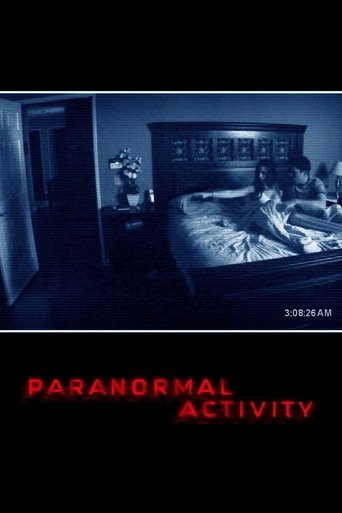
Discover how ‘Paranormal Activity’ is bringing fresh scares to Broadway and redefining the future of stage horror.
After enough years of watching horror movies, you start to see the scares coming.
The camera lingers. The music drops out. Someone investigates a noise that absolutely does not need investigating. You still love the genre, but familiarity has its drawbacks. It gets harder to recapture that feeling of being completely at the mercy of whatever is about to happen.
Watching live actors caught in a frightening situation adds a visceral tension I wasn’t prepared for. I’ve sat through plenty of jump scares in movie theaters, but on a stage, watching them play out with live actors, hits way differently. There is something about witnessing the threat unfold in the same physical space you occupy that makes the whole experience feel less safe.
It reminded me how much fun it is to be scared, but as a weathered horror fan, that feeling is harder to come by. However, this show not only got under my skin, but it also made me think differently about where horror is headed.
Now playing at the August Wilson Theatre, Paranormal Activity: A New Story Live on Broadway is written by Levi Holloway (Grey House) and directed by Felix Barrett, founder of immersive theater pioneers Punchdrunk and co-director of Sleep No More. Simon Friend and Hanna Osmolska lead the producing team through Melting Pot, with Jason Blum and Blumhouse among the production’s partners.
The play follows James and Lou, played by Travis A. Knight and Cher Álvarez, a couple who move from Chicago to London, hoping to escape their past. Unfortunately, whatever haunts them has no respect for international borders.
The production arrives amid a fascinating run of horror properties finding new lives onstage. Beetlejuice had three Broadway engagements and continues playing on London’s West End; Death Becomes Her brought its macabre comedy to Broadway before heading out on a national tour. The Lost Boys found beauty in the musical possibilities of vampirism, using harmony and flight to deepen the film’s ideas about family and belonging. Not to mention the astonishing success of Stranger Things: The First Shadow.
Of course, theater has been inviting monsters inside for a long time. Sweeney Todd, The Phantom of the Opera, and Little Shop of Horrors are hardly newcomers. What feels newly exciting, though, is the range of experiences these adaptations are making possible, and where their creators are willing to take them.
When I saw Stranger Things: The First Shadow, the levitations, transformations, and creature work brought back the sense of amazement I associate with discovering practical effects as a younger horror fan. The on-stage effects and illusions were so spellbinding that for the first time in perhaps two decades, I found myself wondering: how did they do that? In this age of CGI-fatigue and the looming threat of AI, this question is increasingly hard to summon.
Live theater brings it roaring back. When there are actual performers involved, in an actual room, doing it right in front of you, the magic takes hold, and that sense of wonder reawakens.
One of the primary artists responsible is Chris Fisher, who received a Special Tony Award for his work on Stranger Things: The First Shadow. Working alongside Jamie Harrison, Fisher designed the show’s illusions and visual effects, helping translate the supernatural world of the Upside Down into a seemingly impossible live spectacle. He also serves as the international illusions and magic associate for Harry Potter and the Cursed Child and is now the illusions designer on Paranormal Activity.
That progression is worth paying attention to. The stage is fast becoming a place where effects artists and illusionists can develop new ways to astonish us, carrying forward the inventive spirit of horror’s practical effects heyday in the 1970s, ’80s, and ’90s. Now, they face the added challenge of making the impossible happen live, right in front of an audience. As their tools expand, so do the possibilities for horror.
All of which greatly enhances the audience experience. As we all know, horror is better as a shared theatrical experience. This notion is taken to 11 in live theatre.
“I think it comes down to an experiential thing,” Friend says. “Horror is an experience to be had together, and a huge amount of the audience experience of Paranormal Activity is having an auditorium of people scream, and then have a round of nervous laughter all together.”
That cycle is familiar to anyone who has seen a great horror movie with the right crowd. Onstage, it’s way more potent. The performers and the audience are sharing the same moment, and the reactions become part of the experience. You feel the tension gather around you, then hear the entire room release it.
Director Felix Barrett’s background makes him particularly well suited to understanding that audience relationship with immersion. Sleep No More allowed audiences to wander through its world, choosing their own paths through an atmospheric reimagining of Macbeth. Paranormal Activity keeps us in our seats, but Fisher says the ambition to immerse us was there from the beginning.
“Even though the play isn’t in and amongst the audience, we wanted the audience to feel immersed in it,” he explains.
Achieving that means understanding both nuance and restraint.
A jump scare gets a reaction, but it also interrupts the spell of the show because afterward, people laugh, talk, and catch their breath. For a moment, they’re aware of themselves and each other again. Overdoing it can backfire, causing an interruption that keeps the audience from becoming absorbed in the story.
“If you have too many of those [jump scares], then your audience isn’t settled enough to get engrossed,” Fisher says. “It’s so important that you sit in something for a while. You have to get that dread built in. You have to draw the audience in.”
He describes the process almost like plotting a graph. The tension rises, suggesting that something is about to happen, then falls without delivering the expected scare. It rises again. Again, nothing. The audience is gradually being conditioned, their expectations adjusted, until the moment comes to strike on an offbeat when they’re least expecting it.
“I think you get better jumps this way than if you just go, ‘Bang, bang, bang, bang.’ The scares just become diluted,” Fisher explains. “That’s why I think restraint works.”
This is where the craft becomes particularly fascinating. The effects have to work, but within the constraints of pacing, timing, and quantity. An illusion can be technically brilliant and still arrive at the wrong moment. Engineering a scare means understanding what the audience expects, how much tension it can hold, and when it has finally let its guard down.
Getting that balance right has been an ongoing conversation with audiences and an iterative process.
“Every time we’ve done the show, and Broadway was no different, we’ve added more and more effects,” Fisher says.
The Broadway production introduced elements that hadn’t appeared in earlier versions, but adding material also meant protecting the quieter passages that made the scares effective.
“The restraint’s really important. But we just tweaked and tweaked.”
That combination of invention and careful calibration is what makes this such fertile ground for horror. New effects create new opportunities to frighten us, while each audience teaches the artists something about how those effects land. There is still so much to discover about what this experience can be.
For some people, the scares continue long after the curtain call.
“I’ve heard of people grabbing hold of a stranger’s arm next to them and apologizing afterward because they had that moment of terror,” Fisher says. Others have told him they looked over their shoulders on the walk home or checked under their beds afterward.
As a horror fan, I find this not only delightful but downright exciting. These are the feelings we spend years chasing! The possibility that a stage production can make familiar fears feel fresh again is a reason to get excited about where the genre goes next on stage.
“Coming out of the show, you have a new understanding of what theatre can do,” Fisher says.
I certainly did.
Stranger Things expanded my sense of what could be physically achieved onstage. Paranormal Activity expanded my sense of how frightening that experience could become. Together, they suggest an enormous opportunity for horror onstage.
Meanwhile, the appetite for live performance is substantial. Broadway recorded approximately 14.6 million admissions in the 2025–2026 season, with audiences filling 90.8 percent of available seats. broadwayleague.com Horror is finding its place within that audience just as it is in Hollywood, and Fisher says the people behind Paranormal Activity, including Barrett, Holloway, and Jason Blum, are already asking what they might do next. (Halloween the Musical?)
For me, amid all the anxiety about AI and the future of entertainment, this is a welcome reason to be optimistic. There is something refreshingly analog about gathering in a room to witness what real people can do in real time. The performers have to be there. The illusions have to work. We experience the achievement together, in three dimensions, with all the visceral immediacy of human beings doing something extraordinary right in front of us.
And I suspect this return to analog is happening precisely because of how far AI and digital technology have advanced, not in spite of it. The more we can manufacture the appearance of anything, the more we yearn to experience something visceral and potent. A living performer sharing a room with you carries a weight that no generated image can replicate. That audiences are seeking that connection through a theatrical tradition that is thousands of years old gives me enormous hope for the future of entertainment, at a moment when so much of it feels threatened.
I went to Paranormal Activity to get scared, and came away excited about the future of the genre. The stage is giving horror room to experiment, and giving some of us who thought we knew all the tricks the pleasure of being scared all over again.
Paranormal Activity: A New Story Live on Broadway is playing at the August Wilson Theatre in New York, with performances currently scheduled through February 28, 2027. Bring someone whose arm you’re allowed to grab.