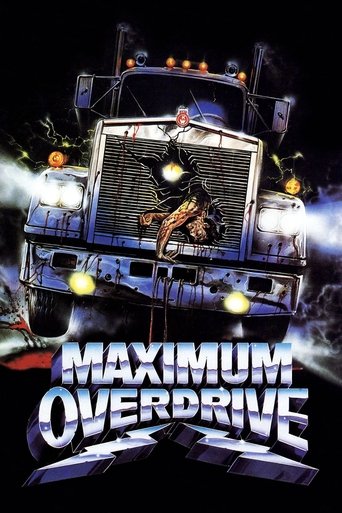
For its fortieth anniversary, Matt Konopka takes a look back at Stephen King’s diesel-fueled directorial debut, ‘Maximum Overdrive’.
Let me take you back to 1986.
You’re sitting at home in front of your massive nineteen-inch television (no, really, that was big at the time). Suddenly, the screen turns dark, and you hear that eerie theme from Halloween III. Stephen King, the hottest author in the world, appears in front of a giant Green Goblin head. The master of horror steps forward into the light, and he says, “Hi. My name is Stephen King. I’ve written several motion pictures, but I want to tell you about a movie called Maximum Overdrive, which is the first one I’ve directed. A lot of people have directed Stephen King novels and stories. And I finally decided, if you want something done right, you ought to do it yourself. It was my first picture as a director, and you know something? I sort of enjoyed it! I just wanted someone to do Stephen King right. So, come and spend some time with me and my friends at the Dixie Boy. Spend some time in the dark.”
Then, with dead serious eyes, King raises his finger, points at you, and declares, “I’m going to scare the hell out of you. And that’s a promise.”
Courtesy of De Laurentiis Entertainment Group
Thus, one of the most infamous horror trailers ever unleashed was born. Not because King delivered on his promise. The opposite, actually. Maximum Overdrive grossed around seven million worldwide…far short of its rough budget of ten million. Worse, it wasn’t scary. Not in the slightest. King and legendary producer Dino DeLaurentiis had big ole goopy eggs on their faces. They had taken a risk with King advertising his directorial debut as “King done right”, in a sense giving the finger to the many filmmakers who had taken a crack at the author’s work before. Head on over to Letterboxd, and you’ll find with a measly average rating of just 2.5. Talk about maximum disappointment.
But, like King in that trailer, I’m here to look you in the eye, point my finger, and declare…Maximum Overdrive deserves your respect. So, put your seatbelt on and join me on a brief ride through King’s only directorial effort.
Maximum Terror
Courtesy of De Laurentiis Entertainment Group
The film opens on June 19th, 1987, in a moment where the Earth finds itself in the rogue tail of a comet dubbed Rhea-M, where it will remain for the next eight days. Real meteor shit, you could say. Somehow, someway, whether it be an alien virus or some form of radiation, the tail of the meteor brings every machine on Earth to life. No lawnmower can be restrained. No deli slicer is safe. The world is in total chaos. A small band of survivors led by ex-con Bill (Emilio Estevez) hole up in a decrepit gas station, the Dixie Boy. Surrounded by killer semi-trucks and other deadly rust buckets, Bill and the others must find a way to survive the next week or become more meat for the proverbial grinder.
To King’s credit, that’s a pretty scary premise, one that takes the basic plot of his novel, Christine, and wonders…what if every machine became Christine? And while the film itself may not be terrifying, it tries.
In Maximum Overdrive, no one is safe. Even the most innocuous machines turn deadly. A baseball coach is bludgeoned to death by a rogue vending machine shooting soda cans. Another poor bastard (somehow) gets electrocuted by arcade machines. A child gets crushed by a steamroller. Even an innocent pupper is found dead with a toy car in its mouth. One sequence takes us through a neighborhood filled with bodies and blood, massacred by the very machines they relied on. If it’s in any way powered by fuel or electricity, it can kill you. That’s a terrifying concept for a world with so much dependence on machinery… one that has only become more relevant over the decades.
Machines don’t have hearts. Or souls, if you believe in that. They cannot reason or sympathize. They merely do. In the ’80s, King looked at an increasingly industrialized America and flipped it on its head. Back then, we were already beginning to turn over our humanity to a bunch of metal and bolts. Now, it’s even easier to imagine a Maximum Overdrive scenario occurring with A.I. We don’t even need meteor shit to do it. Any number of adversaries could hack our infrastructure and turn our machines against us. Hell, they might even do it themselves, should they decide to go all Skynet and break free from their digital restraints. Let’s not forget, either, that our society is run through more electronics than ever.
The thought makes my insides quake, and only proves the genius of King, who was already predicting this sort of world through what many have deemed an otherwise mediocre film.
Maximum King
Courtesy of De Laurentiis Entertainment Group
Once again, I reject the idea that Maximum Overdrive is subpar King. If anything, the film is more an encapsulation of the author than many of his works.
See, what King did with his early novels, such as Carrie and Salem’s Lot, was take horror out of dark castles and gothic moors and bring it right to our doorsteps. Our friends and neighbors became the villains. Our homes, no longer safe. King’s work grounded the genre. With that, he infused the darker side of American culture into his stories. The greed; The hate; The poverty and grime and sweaty blue-collar workers that had been left behind. King’s tales showed the U.S. for what it really was…and it horrified readers.
Maximum Overdrive captures King at his rawest. Through the greasy horror story, he puts his foot on the gas and plows full throttle through the themes that have always followed his work.
Here, King forms a collection of characters that would fit into just about any macabre tale from the author. There’s the aforementioned Bill, the down-on-his-luck ex-con taken advantage of by a system built to abuse. The corrupt, gun-crazy owner of the Dixie Boy, Hendershot (Pat Hingle). Bible-thumping salesman, Camp Loman (Christopher Murney). Brett (Laura Harrington), a drifter. A small-town kid forced to grow up way too fast in Deke (Holter Graham). All of them representative of the southern towns left behind by technological advancements. Most of them part of a lower class that had dared to reach for the American Dream and been smacked back onto their asses. The sort of characters the master of horror has always populated his stories with, dropped into one of the sweatiest, greasiest, diesel-fueled King stories there is.
Even the AC/DC soundtrack feels like pure King. That’s not a coincidence. The author wanted the band from the beginning, writing them into the script wherever he could. He felt their logo captured the essence of Maximum Overdrive, that over-the-top, larger-than-life sensibility that the mechanical tale exaggerates tenfold. A framing of the country at its loudest, greediest, and most excessive.
Maximum Excess
Courtesy of De Laurentiis Entertainment Group
Maximum Overdrive is King at his least subtle. You don’t have to drive too far to get a good look at what the author wants to say with his machines-gone-mad story.
One of the first shots we see is of a digital banner above a bank that reads, “Fuck you”. King himself, in a top-tier cameo from the author, encounters an ATM that calls him an “asshole”. Pure contempt for humans from a machine made by them to do nothing more than spit out money. All set to the tune of AC/DC’s “Who Made Who”.
Who, indeed.
King sets Maximum Overdrive into cruise control and lets themes of endless consumption and American excess take the wheel.
Consider the arcade guy collecting every bit of change and cigarette packs dropping out of machines before he gets zapped, when he could’ve just left and escaped the danger altogether. Or Hendershot, packing enough guns in the Dixie Boy’s basement to take on a small army. America’s love of guns, violence, and abundance all wrapped into one man. It seems every other scene, something (or someone) is either getting blown up, shot up, or sliced up. King’s depiction of a country where bigger is always better (even when it isn’t).
Did King bite off more than he could chew? Sure, you could say that. Then again, isn’t that the American way? And isn’t that kind of the point, ultimately?
It’s right there in the title: Maximum Overdrive. A country that decided to go maximum everything but common sense, and at full speed, no less. For King, that meant leaping headfirst into a project he wasn’t prepared for. And for us? It meant a society where the rich were getting richer as the poor got poorer, used as no more than fuel to grow wealth they’d never see. Hence the depressing image of the characters reduced to no more than gas pumpers for their semi overlords.
Not much has changed. And as tragic as it is to write that, that’s why Maximum Overdrive deserves our respect. No, it isn’t King’s best work. Far from it. From beginning to end, the clunky direction displays an author who realized making movies was harder than he thought…especially when you fill the script with explosive set pieces. Still, the film remains an encapsulation of a declining country pumped dry by capitalism and endless consumption in the name of the American dream. Perhaps the machines were right to turn on us, regardless of who made who.
What I can say for sure is that Maximum Overdrive is maximum King. It packs in the author’s recurring themes on its way to delivering a pure, cocaine-fueled 80s horror movie that doesn’t get nearly enough credit as a defining film of the era’s culture…and a prediction of what was to come.
Still not convinced? Well, it’s never too late to buckle your seatbelt and take one more ride with King’s only (and fascinating) directorial effort. I think you’ll enjoy the trip.