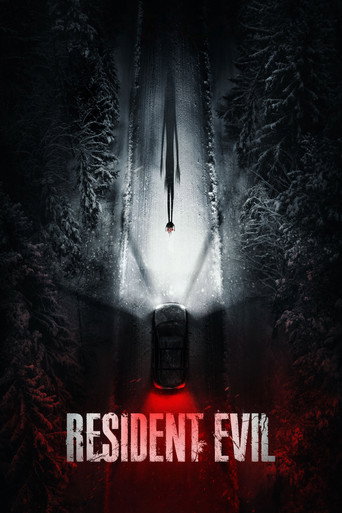
Zach Cregger’s ‘Resident Evil’ Deconstructs the Series’ Final Boss—and Rebuilds It
Zach Cregger’s take on RE beautifully recreates the survival horror experience and pushes the franchise’s boss battles into new territory.

Zach Cregger’s take on RE beautifully recreates the survival horror experience and pushes the franchise’s boss battles into new territory.

What’s so ingenious about this approach is that Bryan is an especially bad player. He makes all the rookie mistakes gamers are prone to upon their initial Resident Evil playthroughs. Bryan is a successful audience surrogate who puts the audience in the Resident Evil headspace. This video game mentality is also present in many other areas of the film, including its big finish.
Cregger’s Resident Evil takes video game elements and creatively subverts them in ways that make sense for a movie. Cregger swaps between first-person and third-person perspective shots, there’s an inspired take on inventory management and weapon upgrades, and there’s copious backtracking and detours in Bryan’s journey. One of the more inspired moments involves Bryan’s discovery of a typewriter. It’s a device that’s completely innocuous and useless in the movie, yet it’s a vital tool in the video games that’s used for saving. Typewriters often appear in Resident Evil games before a major threat attacks, and there’s a good chance of dying. Cregger’s Resident Evil stays true to this by featuring a typewriter to foreshadow that danger is coming.
Cregger adopts the same approach with Resident Evil’s final conflict and how it functions like a gonzo version of the game’s standard boss fights. It’s constructed around the monster’s perspective, after the audience has spent the entire film bonding with Bryan and cheering for their survival. It’d be like if William Birkin – the mutated monster from Resident Evil 2 – were the game’s main character. This shifted perspective wouldn’t be out of place in a Resident Evil video game, and it’s even partially reflected with Ethan Winters in Resident Evil Village.

Cregger subverts expectations with the film’s big monster – equating it with the hero – as the ultimate evolution of the movie’s progressive and disruptive agenda. It lovingly pays tribute to the video game franchise, but it also helps it evolve in this different medium. It creates a final set piece with unprecedented emotional stakes that trumps the hyperbolized nature of the video games’ final fights. These, curiously enough, often have the feeling of big-budget action blockbusters. When Cregger’s Resident Evil finds itself in the same position, it eschews the same temptation in favor of a more intimate, character-driven conclusion that gets to the heart of the monster movie mayhem.
Cregger’s film depicts Bryan caught in the throes of transformation as he scrambles to acquire the cure that will reverse his mutation. It’s a bloody, brutal sequence, albeit one that’s steeped in a desire to see this mutated monster healed rather than killed. It’s an emotionally devastating climax that involves Bryan wrestling with himself and ultimately being unsuccessful in his goal to return to normal. He fails to regain his status as Raccoon City’s potential savior and instead must succumb to going down as the villainous boogeyman.
The early Resident Evil video game endings involve rocket launchers and giant line guns getting thrown to the player so that they can handle the threat and play the part of the big action hero. In Cregger’s Resident Evil, it feels like all this is happening off-screen during Bryan’s plight. It’s the reverse shot of Bryan’s anguish. The moment he loses the last piece of his humanity and the transformation takes over is the moment in which the Resident Evil games expect you to pull the trigger and activate the celebratory final cutscene. It’s the perfect inverse of the traditional Resident Evil final boss fight. Empathy is replaced with badassery.
Cregger’s Resident Evil conclusion is all the more fascinating when it’s juxtaposed against how the previous Resident Evil films have wrapped up. Alice decapitates a zombified Spence Parks in the original 2002 film, a helicopter crashes into Nemesis in Apocalypse, evil clones are consumed by Plaga zombies in Retribution, and Alice defeats Dr. Isaacs with a grenade in The Final Chapter. They’re more conventional showdowns made sense for their respective films, but they’re not exactly innovative or doing much beyond what’s present in the source material. Cregger opts for something that’s arguably polarizing, but different and new. It’s exactly what’s needed here.
The previous Resident Evil film, Resident Evil: Welcome to Raccoon City, recreates Resident Evil 2’s epic finale with a showdown against William Birkin that takes place on a train barreling away from an exploding Raccoon City. The threat is neutralized with an exaggerated rocket launcher blast that leans into spectacle, but not much else. Cregger’s Resident Evil ostensibly features the same degree of explosive chaos, but presents it from an infinitely more personal point of view. There’s loss and tragedy that’s experienced in Bryan’s destruction — both in terms of the loss of his humanity and his literal destruction — whereas Birkin’s death in Welcome to Raccoon City, or the final fights from any of Paul W.S. Anderson’s Resident Evil movies, are meant to be victorious and elicit feelings of success. Cregger’s Resident Evil subverts that success and turns it into dread.