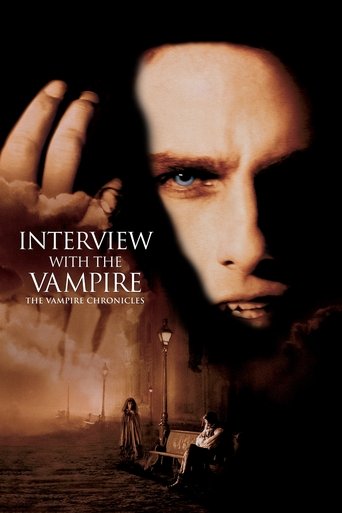
As horror fans sink their teeth into the new 4K version of ‘Interview with the Vampire’, director Neil Jordan discusses the challenges of adapting Anne Rice.
If you hear “vampires” and “the ‘90s,” two key movies come to mind first. One is Bram Stoker’s Dracula, directed by Francis Ford Coppola. Another is Interview with the Vampire, a film that director Neil Jordan has said was directly inspired by Francis Ford Coppola’s flick. As Interview with the Vampire continues to top lists of must-see movies about creatures of the night, Warner Bros. just re-released a newly restored edition of the 1994 film in 4K Ultra HD, available digitally and on Blu-ray now.
Jordan’s film built on the already-grand legacy of Anne Rice, whose book series The Vampire Chronicles continues to have well-read little freaks in a chokehold to this day. The story, presented in a variety of ways now, always goes like this: Louis de Pointe du Lac (in this instance, Brad Pitt) is a sexy little thing with money to burn but is plagued by existential dread. Louis gets mixed up with the vampire Lestat (this time, Tom Cruise), and the incredibly seductive loose cannon ends up baby-trapping Louis by turning a young girl, Claudia (a bratty but feral Kirsten Dunst).
A tale about their supernatural struggle for power and the consequences of these actions unfurls against the backdrop of a hot and dirty New Orleans, and then a dark and sultry Paris. Louis recounts the saga to interviewer Daniel Molloy (Christian Slater), and we’re taken on a journey through a relationship that is enemies to lovers… to enemies… to possibly lovers again.
Jordan’s film had so many elements, apparent to this day, that made it a smash hit: Sumptuous costumes, gorgeous locations, and an evocative score. All of this created perfect window dressing for hot, believable vampires making unfathomably bad decisions, all in the name of eternal damnation. Combined with Rice’s and the about casting, the infamous alleged beef between Louis and Lestat () and ‘90s viewers’ sustained interest in paranormal drama, the movie was seemingly always destined to be an instant classic. But how did this film, whose legacy has endured even with a second reiteration of the story gaining insane popularity, come to be?
Christian Slater and Brad Pitt as Daniel Molloy and Louis de Pointe du Lac; courtesy of Warner Bros.
Paramount acquired the rights to Interview with the Vampire in 1976, the year Louis and Lestat’s ill-fated romance hit print. But the screen adaptation had languished for decades. The way Jordan tells it, the success of his 1992 thriller The Crying Game put him in the running to helm such a big adaptation. But what sealed the deal for Rice, apparently, was Jordan’s previous film, a werewolf film called The Company of Wolves.
“When Anne Rice called me up to persuade me to make this movie, she said to me, ‘Company of Wolves is Lestat’s favorite film,’” Jordan told me over Zoom. He remembers thinking, “This is really weird. You’re talking about your fictional character as if he’s sitting there beside you, having a cup of tea with you.” This was par for the course for the author, who passed at age 80 in 2021; here is Rice talking about Lestat in the context of Memnoch the Devil in the ‘90s and a fan-compiled archive of Rice posting as Lestat on Facebook.
“It’s also weird that I was kind of delighted that she liked the movie,” Jordan admitted, telling me that he was already dreaming up a vampire film companion to The Company of Wolves. “So this, to me, was a perfect kind of follow-on to that experience.” And it was.
Rice wrote the script, which was at first a pretty rigid North Star. Over the decades of being stuck in development hell, the script had evolved. Jordan asked Warner Bros. and the film’s producers, “Can I do my own pass on this? Because too much from the book has been taken out,” he recalled. “I had to reintroduce a lot of eroticism. Something had gone missing through the years.”
He added, “I tried to make something that was as honest to the books as I could possibly do.”
A Process of Endless Night
Even if the film’s ideological direction had been solidified, logistical challenges arose. Famously, Interview with the Vampirewas shot at night almost exclusively. This is something Brad Pitt publicly lamented in 2011 and Jordan referenced in our conversation when I asked him about filming in Louisiana. “New Orleans was amazing… We never saw the daylight,” Jordan quipped, joking that he has never seen the Mississippi River in the sunlight. “We lived like vampires when we made the movie.”
Even before the film touched down in the bayou, a casting musical chairs plagued production behind the scenes. Originally, before Pitt was cast, Rice wanted Alain Delon to play Louis, according to Rice biographer Katherine Ramsland. Then there was the matter of Louis’ maker. Word on the street is that Rice and fans wanted Julian Sands to play Lestat, but studios allegedly felt like Sands wasn’t well-known enough, even after ARoom with a View, to helm this kind of blockbuster.
After Pitt was cast as Louis, Pitt and Rice were set on the idea of Daniel Day-Lewis as Lestat, but he turned the role down. Then Jordan met with Cruise and, as Jordan told TheTelegraph, he was both intrigued and unsettled. (Much to Rice and fans’ initial chagrin, Jordan stood firm on his decision to champion Cruise’s icy beauty.) Likewise, instead of Slater, River Phoenixwas supposed to play Molloy, but passed away before filming started. Julia Stiles read for Claudia, but Dunst ultimately secured the role.
The Matter of Claudia
Alongside Pitt as the vampire Louis, Kirsten Dunst as the vampire Claudia; courtesy of Warner Bros.
But all is well that ends well. Rice loved the IWTV casting when it was all said and done — explicitly stating she enjoyed how Cruise, Pitt and Antonio Banderas as Armand showed up on the screen. Rice also called Dunst “terrific” as Claudia; Jordan also marveled to me about Dunst’s presence, even at such a young age.
“The weird thing is this: She delivers this chilling performance at the age of 12,” Jordan said of Dunst before she starred in Bring It On and breathed life into Mary Jane in the Sam Raimi Spider-Man adaptations. “She was great in them all, but it was such an all-American girl thing.”
“It’s only lately that she’s returned to the darkness that she displayed when she was so young,” he added, recounting how, at the time of chatting, he had recently watched Lars Von Trier’s Melancholia. “I could see the same intensity — the same kind of bleakness,” he continued, calling Dunst one of the most “interesting” actors working.
Claudia’s power is also a focal point of our conversation when I asked about AMC’s adaptation of The Vampire Chronicles, which has two seasons of Interview with the Vampire and one season ofThe Vampire Lestat. In the AMC Anne Rice universe, Jacob Anderson is the new Louis, Sam Reid is the new Lestat, and Bailey Bass and Delainey Hayles both have been the new Claudia. In this adaptation, Claudia gets turned as a teenager, not as a child — something that surprised Jordan.
“The only thing I didn’t understand was why they made Claudia so old. When I was making the movie, I thought, ‘This is a beautiful thing.’ You get two men stuck together in a relationship that both find unbearable. One of them wants to leave, and the other says, ‘I don’t want you to leave.’ And he makes a child, so he knows once he’s made the child, [Louis] will never leave,” Jordan said. “If she’s not a child, it’s not the same thing, really, in a strange way.”
A Faithfulness to the Vision
Director Neil Jordan directs Pitt as Louis; behind-the-scenes photo courtesy of Warner Bros.
Through trials and tribulations came the kind of film that is beloved by horror audiences and gets restored with reverence. Along with the initial commentary from Jordan, Rice, and Banderas, the new restoration also has featurettes about Interview with the Vampire’s cinematography (including film editor Mick Audsley and director of photography Philippe Rousselot) and its distinct romantic goth visual identity (with words from production designer Dante Ferretti). This release also has a new collection of deleted scenes.
When asked if he would have done anything differently, Jordan told me that he probably wouldn’t have. “I did my best to make it scary,” he said, adding that the fear factor was an issue when “you’re making a movie from the point of view of the monster.” The film also doesn’t have any jump scares. “How do you create the kind of terror that people are used to from horror movies? It became more about dread,” he said.
Conversations about how Jordan designed Interview with the Vampire’s fear framework remind me of how, prior to the film’s release in November 1994, an early, bloodier cut ofInterview with the Vampire was shown to test audiences. I asked Jordan about this, and he told me, “When this Blu-ray was announced, I did try to track my original cut of the movie.” But ultimately, he couldn’t find it in Warner Bros. vaults. This digging endeavor did, however, uncover the deleted scenes being included in the restored digital and physical releases. “You’ll see the full glory of what we shot in those.”
Jordan’s faithfulness to the original vision, put forth by the book, is endearing — for lack of a better word. Any real lover of horror literature can respect this. Interview the film recently celebrated its 30th anniversary, and this year, Interviewthe book celebrates its 50th anniversary. I wanted to hear in his own words why Rice’s myths and legends endured. His answer was straightforward.
Anne Rice “reinvented the figure of the vampire” as we’ve known it since Bram Stoker’s Dracula. The synchronicity of Jordan saying this, after citing Coppola’s Bram Stoker’s Dracula as his inspiration for his Rice adaptation, is not lost on me.
“Anne, she broadened it out into this kind of Byronic, romantic kind of zone. I don’t think [the genre] has ever recovered from what she’s done,” he said. “The idea of vampires as doomed, attractive figures — as doomed outsiders — that will express whatever outsiderness we want to express came from her, didn’t it?”
![‘Interview With the Vampire’ Director Talks Anne Rice, Lestat, Claudia & the Legacy of All Three [Exclusive]](https://www.dreadcentral.com/wp-content/uploads/2026/09/LESTAT-LOUIS-1600x900.jpg)