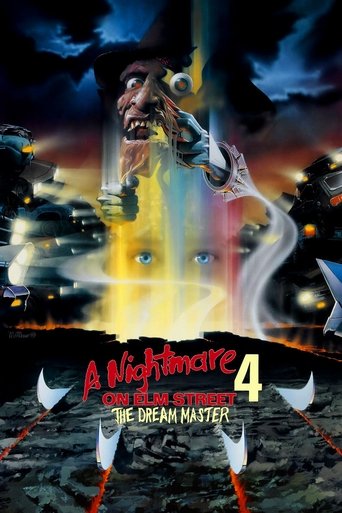
‘The Dream Master’ is an underrated, creatively ambitious sequel whose absurd humor and spectacular practical effects reflect genuine passion.
Far too commonly, many iconic horror franchises devolve into something low-effort and cheap, or divert from their roots into self-parody in a really demeaning, negative way. What starts as a legitimate and genuine attempt at genre filmmaking tends to get worse over time, especially after the third or fourth entry. With Halloween, the next couple of decades of movies after Season of the Witch were a big dip in impact and quality. It took a complete reimagining with Rob Zombie to infuse any juice or momentum back into the series. With The Texas Chainsaw Massacre, the series could really never find its footing again after the successful genre-fusing sequel.
We even saw an exploration of a franchise’s life cycle in Jane Schoenbrun’s Teenage Sex and Death at Camp Miasma earlier this year–even the most iconic and influential franchises tend to lose their soul. So, I think for many, that loss of soul for the Nightmare on Elm Streetfranchise is the fourth entry, The Dream Master. The three before it are completely iconic and each has its own sturdy, distinct reputation. The first, as the originator, is about as iconic as American horror gets and is a cornerstone of the subgenre’s development in the 1980s. While the second wasn’t initially very well-received, and still has some mixed reviews, it has gained a dedicated cult following due to its emotional complexity and explorations of queer/LGBTQ identity. The third is just a great movie, one that has gained growing mountains of appreciation over time, and it’s not uncommon at all for it to be considered the best Nightmare on Elm Street entry.
The fourth was a box-office hit, but it has had a mixed reception since its release. It hasn’t had a reclamation akin to the second. Consistently, the fourth is where this respect and love dissipate, with many seeing the franchise slip into a dark purgatory of lackadaisical execution and cheap self-parody until Wes Craven’s return in 1994. I strongly disagree here–I think the fourth entry has an incredibly strong atmosphere, great practical effects, a tight grip on tone, and some truly electric and genuinely creative sequences.
Even from the opening credits, we get a gorgeously shot and sequenced reintroduction of danger bleeding from the sleep realm. It immediately showcases some of the best aspects of this film–fun, athletic camera movement, beautiful set pieces, dynamic color and lighting, and a dose of humor that works well for the intended tone.
We are reintroduced to the Dream Warriors who defeated Freddy in the previous entry, and their demise begins when Kincaid’s (Ken Sagoes) dog pisses fire on Freddy’s dream grave, opening a gate to hell, where his bones and matter, through wet, squelchy practical effects, inexplicably rejoin to bring him back to life. That is the movie we are watching; that is the movie that The Dream Master is, which is why I think it’s underrated. There is a reckless and absurd quality to it that’s addicting to watch unfold. The best parts of these movies are their sporadic blasts of creativity and practical ingenuity. While the first three movies are certainly nightmares, this one is a fever dream.
There is a real passion coming from the director’s chair, and that makes sense, considering Director Renny Harlin campaigned vigorously to New Line Cinema about directing this entry, because he was such a huge fan of the franchise. Harlin’s vision had always been to create something that showed love for the franchise and the character, while digging deeper into the silly and ridiculous pitch that the franchise has always operated at. It is filled to the brim with insane one-liners and maximalist dream sequence set pieces (I mean, really, starting off with a literal endless junkyard-hell-world and a killer mermaid water bed is an incredible way to open).
While the comedy is surely more developed and intentional in The Dream Master, I think it complements, rather than degrades, the source material. Freddy is a funny, conniving character from the start, and this movie leans the entire film’s tone into Freddy’s dark comedy, rather than making it feel like it’s at the franchise’s expense.
After two “dream warriors” from the prior movie, Kincaid and Joey (Rodney Eastman), get killed by Freddy, the last remaining Dream Warrior, the protagonist of the movie, Kristen (Tuesday Knight), realizes she’s the last one Freddy’s after. I’m not going to sit here and say that everything lands–Freddy on the beach with sunglasses, I think may be the main instance of the campiness reaching an eye-rolling point. But I still could see people finding it funny–again, the ridiculousness and smugness of Freddy is elevated movie after movie, and this feels like a logical place to reach.
Even after this incredibly silly scene, we immediately get a great scene of Freddy’s victim’s faces grotesquely protruding from his chest and torso–it’s a striking, weird image that has really resonated with me. That entire scene feels incredibly feverish, and I think works well just as a hallucinatory experience.
That’s really what I think holds up about this–it doesn’t really make logical sense, and its focus is fully on mood and dream set pieces take center stage. I get why, for some, the gags and the heightened comedic and ridiculous atmosphere feel like a deflation of the franchise and the character, but at the end of the day, the movie is incredibly fun and well-made.
We might get the beach scene, we might get the dojo scene (which is probably the most bizarre and poorly aged bit from the entire series), but we also get the incredible practical effects of Sheila’s (Toy Newkirk) reduction to a deflated corpse. We also get the movie theater sequence and the roach transformation back-to-back–I think these are genuinely stunning pieces of effects work. Freddy’s “I love soul food” line also makes me laugh out loud.
The last act of this movie is where everything truly shines. The finale is bombastic–blazing bold colors and smoke machines and a rapturous final encounter with Freddy. It is an explosive and genuinely shocking conclusion–one that feels perfect for the movie.
I think there’s a lifecycle for any series or franchise. At some point, there will be bombs–something can only be recreated and corporatized so much before all its soul is lost and the wheels completely fall off. I don’t think that’s what’s happening here–I wish horror sequels were always made with this much passion behind the camera.