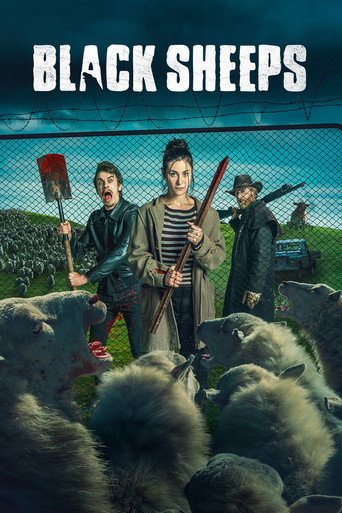
‘Black Sheeps’ is a joyous reunion that proudly continues the gonzo Kiwi horror tradition. Check out our 4-star review here.
“There are 40 million sheep in New Zealand… and they’re pissed off!” So declared the tagline for 2006’s cult New Zealand horror-comedy Black Sheep. It’s a long-standing fact that New Zealand has always had more sheep than people. In 2026, the statistics have changed considerably, with 23 million sheep versus 5.3 million people, but in Jonathan King’s legacy sequel, Black Sheeps, those sheep are still pissed off and still have a propensity for tearing out the throats and innards of their hapless human overlords.
Twenty years have passed since the bloodbaaaath on Glenolden Station, which is now a no-go zone surrounded by high fences, warning signs, and patrolled by a shotgun-wielding figure known as The Shepherd. The genetic mutations and were-sheep have largely been contained, with the occasional outbreak of were-sheepism quickly dealt with in a nearby lab.
Oats (Tabatha Killick) is an idealistic young scientist who suspects something is wrong at Glenolden Station, especially after she discovers her own parents are part of a sheep cult that wears woolly sheep costumes and plans to break into the farm. Also along for the muster is Maia (Lucia Davison), a young girl who has just moved with her family into a new eco-housing development, one that borders the farm, and looks down on a mysterious sheep-shaped structure.
The original film’s protagonist, Henry Oldfield (Nathan Meister), returns in a more supporting role, older, grizzled, reclusive, and protective of the secret his family farm holds. A couple of other characters also make a surprise return from the original film, and their identities won’t be revealed here, since their side story is one of the film’s most delightful and disgusting parts.
In the intervening years, no permanent cure has been found for the mutation, only a rapidly dwindling serum that keeps it at bay for a time, which has consequences for a couple of the legacy characters. Oats’ mission to finally crack the cure leads her back to the Oldfield Homestead, where its sole inhabitant may provide the key.
Taking a page from James Cameron’s book, King adds an S to the title of his sequel (no word on whether it was a $ for pitching purposes) and expands the world beyond the farm and into the surrounding community of Woolston. And while many of the elements of the first film remain, right down to a climactic sheep massacre, the film is no mere retread. The ambition on display is refreshing for a horror sequel where diminishing returns can often be the case, even if it slightly overstuffs the 97-minute film with extra characters and subplots, some of which work better than others.
The Kiwi-centric humor is of the broad, slapstick variety, and although it occasionally misses the mark, there is always another over-the-top gore gag or absurdity just around the corner, like the sight of a Were-sheep trapped inside a self-driving car.
The sheep cult are an enjoyably motley bunch, and as with most community groups/cults, there is a lot of in-fighting and confusion over their mission and messaging. Their ranks include Oat’s easily swayed parents, Colleen (Heather O’Carroll), the fastidious leader of the sheep cult, and The Ram, a towering fellow who makes for one of the film’s most ‘memora-ball’ sight gags.
Whereas the first film took potshots at genetic modification and well-meaning but misguided eco-warriors, Black Sheeps skewers the rise of hive-mind cults in the post-COVID era. Also in the crosshairs are so-called eco-businesses that rely heavily on non-eco-friendly technology, and their customers, who smugly pat themselves on the back before retreating into the hypnotic blue screens of their smartphones.
The genetic mutation itself is a malleable concoction in terms of its properties, but this just allows King and his makeup FX crew to conjure up all manner of zombified man-eating sheep, the humanoid Were-Sheep, and another glorious creature that is one part Jabba the Hutt and one part The Thing (1982).
Weta Workshop’s practical FX are incredible here, with CGI being kept to the bare minimum for the most part. The bipedal Were-Sheep are the best Were-creature FX put on screen in a long time, with a tangible weight and menace that pixels often struggle to muster, and further proof that practical FX should be used wherever possible to realize such creatures.
Special mention needs to be made of the score by returning composer Victoria Kelly, who again fills the rolling green New Zealand hills with her darkly whimsical orchestrations, lending an almost fairy-tale feel to the proceedings. A gory horror comedy like Black Sheeps probably didn’t need such a classy score, but like Christopher Young’s similarly robust score for Sam Raimi’s Drag Me to Hell, it helps elevate the material even further.
What also stands out is King’s (and his crew’s) palpable and infectious sense of glee at being allowed to play in this bloody paddock again – it feels like a band getting back together twenty years later and picking up where they left off, playing a few of the hits and dropping some new banger tunes along the way. The fact that they get to do so while being so unabashedly silly makes it even better.
The first film was another notch on the blood-stained belt of New Zealand’s horror comedy tradition; a lineage that arguably began with 1984’s Death Warmed Up and continued with young Kiwi upstart director Peter Jackson’s homemade alien splatter fest Bad Taste (1988), gonzo puppet schlock Meet the Feebles (1990), and ‘50s-set zombie all-timer, Brain Dead (Dead Alive in the Northern Hemisphere).
Black Sheeps follows on from the recent Deathgasm 2: Goremageddon and Mum, I’m Alien Pregnant in what is a welcome renaissance for Kiwi horror comedies, and it does the genre proud with plenty of throat ripping, bodily destruction, and bucket loads of blood and embryonic fluids mixed in with the laughs. I, for one, will never tire of watching someone desperately wrestle with a rabid sheep for their own intestines as they are being pulled from their stomach.
While it doesn’t quite reach the disgusting highs (or lows) of the first film’s offal pit scene (one of this writer’s worst nightmares, having grown up on a New Zealand farm), it gleefully honors the country’s splatter-comedy tradition with a more ambitious film that promises a bloody good time for fans of the aforementioned Jackson films. Here’s hoping it’s not another 20 years before Black Sheeps’s (Black Threeps?) comes trotting along.